Module 3 · Build real CRUD features
3.1 Routers, and organisations you can create and edit
Split routes into Express routers before app.js becomes unreadable, then build list, view, create and update for organisations with a shared form.
Starting point
All routes live in src/app.js, and only issues have pages. Organisations and buildings exist in the database but nowhere in the UI.
Outcome
src/├── app.js (settings, middleware, mounting, error handling)├── lib/ids.js (new: parseId)├── models/organisations.js (new)├── models/buildings.js (+ listBuildingsForOrganisation)└── routes/ ├── issues.js (moved from app.js) └── organisations.js (new)views/organisations/ index.ejs show.ejs form.ejstest/organisations.test.js/organisations lists both organisations with their building counts. You can open one, see its buildings, create a new organisation and rename it.
The problem
src/app.js is already 110 lines, and we are about to add organisations, buildings and inspections, each with five to eight routes. One file would grow past 500 lines, with every resource's validation and helpers mixed together. Express has a built-in answer: a router is a mini-application with its own routes, which you mount at a path prefix.
Build it
1. Move parseId to a shared module
Every resource needs to validate IDs. Create src/lib/ids.js with the function from app.js:
const MAX_INTEGER = 2147483647; // Returns a positive integer that fits a PostgreSQL integer column, or null.export function parseId(value) { if (typeof value !== 'string' || !/^[1-9][0-9]{0,9}$/.test(value)) { return null; } const id = Number(value); return id <= MAX_INTEGER ? id : null;}2. An issues router
Create src/routes/issues.js. The code is the issue code from app.js, with two mechanical changes: routes are registered on issuesRouter instead of app, and their paths drop the /issues prefix, because the router is mounted at /issues:
import express from 'express';import { listIssues, findIssue, createIssue } from '../models/issues.js';import { listBuildings } from '../models/buildings.js';import { PG_ERRORS } from '../db.js';import { parseId } from '../lib/ids.js'; export const issuesRouter = express.Router(); const PRIORITIES = ['low', 'medium', 'high', 'critical']; function validateIssue(input) { const errors = {}; const title = typeof input.title === 'string' ? input.title.trim() : ''; const description = typeof input.description === 'string' ? input.description.trim() : ''; const buildingId = parseId(input.building_id); if (title.length < 3 || title.length > 200) { errors.title = 'Title must be between 3 and 200 characters.'; } if (description.length > 2000) { errors.description = 'Description must be at most 2000 characters.'; } if (!PRIORITIES.includes(input.priority)) { errors.priority = `Priority must be one of: ${PRIORITIES.join(', ')}.`; } if (buildingId === null) { errors.building_id = 'Choose a building.'; } return { errors, values: { title, description, priority: input.priority, building_id: buildingId } };} async function renderIssueForm(res, status, { values = {}, errors = {} } = {}) { const buildings = await listBuildings(); res.status(status).render('issues/new', { title: 'Report an issue', values, errors, priorities: PRIORITIES, buildings });} issuesRouter.get('/', async (req, res) => { const issues = await listIssues(); res.render('issues/index', { title: 'Maintenance issues', issues });}); issuesRouter.get('/new', async (req, res) => { await renderIssueForm(res, 200);}); issuesRouter.post('/', async (req, res) => { const { errors, values } = validateIssue(req.body ?? {}); if (Object.keys(errors).length > 0) { return renderIssueForm(res, 400, { values, errors }); } let issue; try { issue = await createIssue(values); } catch (err) { if (err.code === PG_ERRORS.FOREIGN_KEY_VIOLATION) { return renderIssueForm(res, 400, { values, errors: { building_id: 'Choose a building.' } }); } throw err; } res.redirect(303, `/issues/${issue.id}`);}); issuesRouter.get('/:id', async (req, res) => { const id = parseId(req.params.id); const issue = id === null ? null : await findIssue(id); if (!issue) { return res.status(404).render('not-found', { title: 'Not found', path: req.originalUrl }); } res.render('issues/show', { title: issue.title, issue });});One subtle change: inside a router req.path is relative to the mount point (/101), so the 404 page now uses req.originalUrl (/issues/101).
3. Data access for organisations
Create src/models/organisations.js:
import { query } from '../db.js'; export async function listOrganisations() { const { rows } = await query( `SELECT o.id, o.name, count(s.id)::int AS building_count FROM organisations o LEFT JOIN buildings s ON s.organisation_id = o.id GROUP BY o.id ORDER BY o.name`, ); return rows;} export async function findOrganisation(id) { const { rows } = await query('SELECT id, name, created_at, updated_at FROM organisations WHERE id = $1', [id]); return rows[0] ?? null;} export async function createOrganisation({ name }) { const { rows } = await query('INSERT INTO organisations (name) VALUES ($1) RETURNING id', [name]); return rows[0];} export async function updateOrganisation(id, { name }) { const { rows } = await query( 'UPDATE organisations SET name = $2, updated_at = now() WHERE id = $1 RETURNING id', [id, name], ); return rows[0] ?? null;}count(s.id)::int: PostgreSQL'scountreturns abigint, which can exceed JavaScript's safe integer range, sopgreturns it as a string ("2"). The::intcast converts it in SQL, where we know the number is small.UPDATE ... RETURNING idreturns no row when the ID does not exist, soupdateOrganisationreturnsnulland the route can answer 404.- We set
updated_at = now()ourselves. PostgreSQL does not update it automatically.
The organisation page lists its buildings. Add a function to src/models/buildings.js:
ORDER BY o.name, s.name`, ); return rows;} export async function listBuildingsForOrganisation(organisationId) { const { rows } = await query( `SELECT s.id, s.name, count(e.id)::int AS issue_count FROM buildings s LEFT JOIN issues e ON e.building_id = s.id WHERE s.organisation_id = $1 GROUP BY s.id ORDER BY s.name`, [organisationId], ); return rows;}Show the whole src/models/buildings.js after this change
import { query } from '../db.js'; export async function listBuildings() { const { rows } = await query( `SELECT s.id, s.name, s.organisation_id, o.name AS organisation_name FROM buildings s JOIN organisations o ON o.id = s.organisation_id ORDER BY o.name, s.name`, ); return rows;} export async function listBuildingsForOrganisation(organisationId) { const { rows } = await query( `SELECT s.id, s.name, count(e.id)::int AS issue_count FROM buildings s LEFT JOIN issues e ON e.building_id = s.id WHERE s.organisation_id = $1 GROUP BY s.id ORDER BY s.name`, [organisationId], ); return rows;}4. The organisations router
Create src/routes/organisations.js:
import express from 'express';import { listOrganisations, findOrganisation, createOrganisation, updateOrganisation } from '../models/organisations.js';import { listBuildingsForOrganisation } from '../models/buildings.js';import { parseId } from '../lib/ids.js'; export const organisationsRouter = express.Router(); function validateOrganisation(input) { const errors = {}; const name = typeof input.name === 'string' ? input.name.trim() : ''; if (name.length < 2 || name.length > 100) { errors.name = 'Name must be between 2 and 100 characters.'; } return { errors, values: { name } };} function renderForm(res, status, { organisation = null, values = {}, errors = {} }) { res.status(status).render('organisations/form', { title: organisation ? `Edit ${organisation.name}` : 'New organisation', action: organisation ? `/organisations/${organisation.id}/edit` : '/organisations', organisation, values, errors, });} // Loads the organisation named by :id, or answers 404. Returns null when it answered.async function loadOrganisation(req, res) { const id = parseId(req.params.id); const organisation = id === null ? null : await findOrganisation(id); if (!organisation) { res.status(404).render('not-found', { title: 'Not found', path: req.originalUrl }); return null; } return organisation;} organisationsRouter.get('/', async (req, res) => { res.render('organisations/index', { title: 'Organisations', organisations: await listOrganisations() });}); organisationsRouter.get('/new', (req, res) => { renderForm(res, 200, {});}); organisationsRouter.post('/', async (req, res) => { const { errors, values } = validateOrganisation(req.body ?? {}); if (Object.keys(errors).length > 0) { return renderForm(res, 400, { values, errors }); } const created = await createOrganisation(values); res.redirect(303, `/organisations/${created.id}`);}); organisationsRouter.get('/:id', async (req, res) => { const organisation = await loadOrganisation(req, res); if (!organisation) return; const buildings = await listBuildingsForOrganisation(organisation.id); res.render('organisations/show', { title: organisation.name, organisation, buildings });}); organisationsRouter.get('/:id/edit', async (req, res) => { const organisation = await loadOrganisation(req, res); if (!organisation) return; renderForm(res, 200, { organisation, values: organisation });}); organisationsRouter.post('/:id/edit', async (req, res) => { const organisation = await loadOrganisation(req, res); if (!organisation) return; const { errors, values } = validateOrganisation(req.body ?? {}); if (Object.keys(errors).length > 0) { return renderForm(res, 400, { organisation, values, errors }); } await updateOrganisation(organisation.id, values); res.redirect(303, `/organisations/${organisation.id}`);});Notes on the design:
- One form template for create and edit.
renderFormsets the heading and the form'saction. The edit form starts with the current values. loadOrganisationis the "find it or 404" step that every/:idroute needs. It returnsnullafter it has answered, and the route stops withif (!organisation) return;. Remember this function: in Module 5 the same place decides whether you may see the organisation.- Edit uses
POST /organisations/:id/edit. HTML forms can only sendGETandPOST, so we use a distinct URL instead ofPUT. The same goes for delete in the next lesson.
5. Views
<%- include('../partials/head') %><div class="page-header"> <h1>Organisations</h1> <a class="btn btn-primary" href="/organisations/new">New organisation</a></div><table class="data"> <thead><tr><th>Name</th><th>Buildings</th></tr></thead> <tbody> <% for (const organisation of organisations) { %> <tr> <td><a href="/organisations/<%= organisation.id %>"><%= organisation.name %></a></td> <td><%= organisation.building_count %></td> </tr> <% } %> </tbody></table><%- include('../partials/foot') %><%- include('../partials/head') %><p class="breadcrumbs"><a href="/organisations">Organisations</a> / #<%= organisation.id %></p><div class="page-header"> <h1><%= organisation.name %></h1> <div class="actions"> <a class="btn" href="/organisations/<%= organisation.id %>/edit">Edit</a> </div></div> <h2>Buildings</h2><% if (buildings.length === 0) { %> <p class="empty">This organisation has no buildings yet.</p><% } else { %> <table class="data"> <thead><tr><th>Building</th><th>Issues</th></tr></thead> <tbody> <% for (const building of buildings) { %> <tr><td><%= building.name %></td><td><%= building.issue_count %></td></tr> <% } %> </tbody> </table><% } %><%- include('../partials/foot') %><%- include('../partials/head') %><h1><%= title %></h1><form method="post" action="<%= action %>" class="form" novalidate> <div class="field<%= errors.name ? ' has-error' : '' %>"> <label for="name">Name</label> <input id="name" name="name" value="<%= values.name ?? '' %>" maxlength="100" required> <% if (errors.name) { %><p class="field-error"><%= errors.name %></p><% } %> </div> <div class="form-actions"> <button type="submit" class="btn btn-primary"><%= organisation ? 'Save changes' : 'Create organisation' %></button> <a class="btn" href="<%= organisation ? `/organisations/${organisation.id}` : '/organisations' %>">Cancel</a> </div></form><%- include('../partials/foot') %>Add the link to the navigation:
<a href="/issues">Issues</a> <a href="/organisations">Organisations</a>Show the whole views/partials/nav.ejs after this change
<header class="site-header"> <div class="container header-inner"> <a class="brand" href="/">Caretaker</a> <nav class="main-nav" aria-label="Main"> <a href="/issues">Issues</a> <a href="/organisations">Organisations</a> </nav> </div></header>6. Slim down app.js
Replace the whole file. Everything about issues has moved to the router; app.js keeps settings, middleware, mounting and error handling:
import express from 'express';import path from 'node:path';import { issuesRouter } from './routes/issues.js';import { organisationsRouter } from './routes/organisations.js'; export const app = express(); app.set('view engine', 'ejs');app.set('views', path.join(import.meta.dirname, '..', 'views'));app.locals.formatDate = (value) => new Date(value).toLocaleString('en-IE', { dateStyle: 'medium', timeStyle: 'short', timeZone: 'UTC' }); app.use((req, res, next) => { if (process.env.NODE_ENV === 'test') { return next(); } const started = Date.now(); res.on('finish', () => { console.log(`${req.method} ${req.originalUrl} -> ${res.statusCode} (${Date.now() - started} ms)`); }); next();}); app.use(express.static(path.join(import.meta.dirname, '..', 'public')));app.use(express.urlencoded({ extended: false })); app.get('/', (req, res) => { res.redirect('/issues');}); app.use('/issues', issuesRouter);app.use('/organisations', organisationsRouter); app.use((req, res) => { res.status(404).render('not-found', { title: 'Not found', path: req.originalUrl });}); app.use((err, req, res, next) => { const status = err.status ?? 500; if (status >= 500) { console.error(err); } const message = err.expose ? err.message : 'Something went wrong'; res.status(status).render('error', { title: 'Error', status, message });});app.use('/issues', issuesRouter) sends every request whose path starts with /issues to the router, with that prefix removed. The order of mounting still matters: routers come before the 404 handler.
7. Tests for organisations
import { test, before, after } from 'node:test';import assert from 'node:assert/strict';import request from 'supertest';import { app } from '../src/app.js';import { pool } from '../src/db.js';import { resetDatabase } from './helpers.js'; before(resetDatabase);after(() => pool.end()); test('GET /organisations lists organisations with building counts', async () => { const res = await request(app).get('/organisations'); assert.equal(res.status, 200); assert.match(res.text, /Liffey Estates<\/a><\/td>\s*<td>2<\/td>/); assert.match(res.text, /Harbour Lets/);}); test('GET /organisations/1 shows its buildings, not other organisations\' buildings', async () => { const res = await request(app).get('/organisations/1'); assert.equal(res.status, 200); assert.match(res.text, /Dublin Offices/); assert.match(res.text, /Cork Apartments/); assert.doesNotMatch(res.text, /Galway Studios/);}); test('POST /organisations validates and creates', async () => { const bad = await request(app).post('/organisations').type('form').send({ name: ' ' }); assert.equal(bad.status, 400); assert.match(bad.text, /Name must be between 2 and 100 characters/); const good = await request(app).post('/organisations').type('form').send({ name: 'Riverside Lettings' }); assert.equal(good.status, 303); const page = await request(app).get(good.headers.location); assert.match(page.text, /<h1>Riverside Lettings<\/h1>/);}); test('POST /organisations/:id/edit renames the organisation', async () => { const res = await request(app).post('/organisations/2/edit').type('form').send({ name: 'Harbour Lets Ltd' }); assert.equal(res.status, 303); const page = await request(app).get('/organisations/2'); assert.match(page.text, /<h1>Harbour Lets Ltd<\/h1>/);}); test('unknown organisations are 404', async () => { assert.equal((await request(app).get('/organisations/999')).status, 404); assert.equal((await request(app).post('/organisations/999/edit').type('form').send({ name: 'Nope' })).status, 404);});Run and inspect
npm test
> caretaker@1.0.0 test
> node --env-file=.env.test --test --test-concurrency=1 --test-reporter=spec "test/**/*.test.js"
✔ GET /issues lists issues from the database (65.192458ms)
✔ GET /issues/101 shows one issue with its building (3.015292ms)
✔ GET /issues/:id answers 404 for unknown or malformed ids (5.9875ms)
✔ POST /issues re-renders the form with errors (6.716125ms)
✔ POST /issues stores the issue and redirects to it (6.084041ms)
✔ POST /issues with a building that does not exist is a form error, not a 500 (16.792583ms)
✔ the stored row has the cleaned values (3.241417ms)
✔ GET /organisations lists organisations with building counts (53.028459ms)
✔ GET /organisations/1 shows its buildings, not other organisations' buildings (3.428709ms)
✔ POST /organisations validates and creates (10.27125ms)
✔ POST /organisations/:id/edit renames the organisation (5.611458ms)
✔ unknown organisations are 404 (4.552084ms)
ℹ tests 12
ℹ suites 0
ℹ pass 12
ℹ fail 0
ℹ cancelled 0
ℹ skipped 0
ℹ todo 0
ℹ duration_ms 391.383125Both test files ran, one after the other, each starting from a freshly seeded database. Start the app and look:
npm run dev
> caretaker@1.0.0 dev
> node --env-file=.env --watch src/server.js
Caretaker listening on http://localhost:3000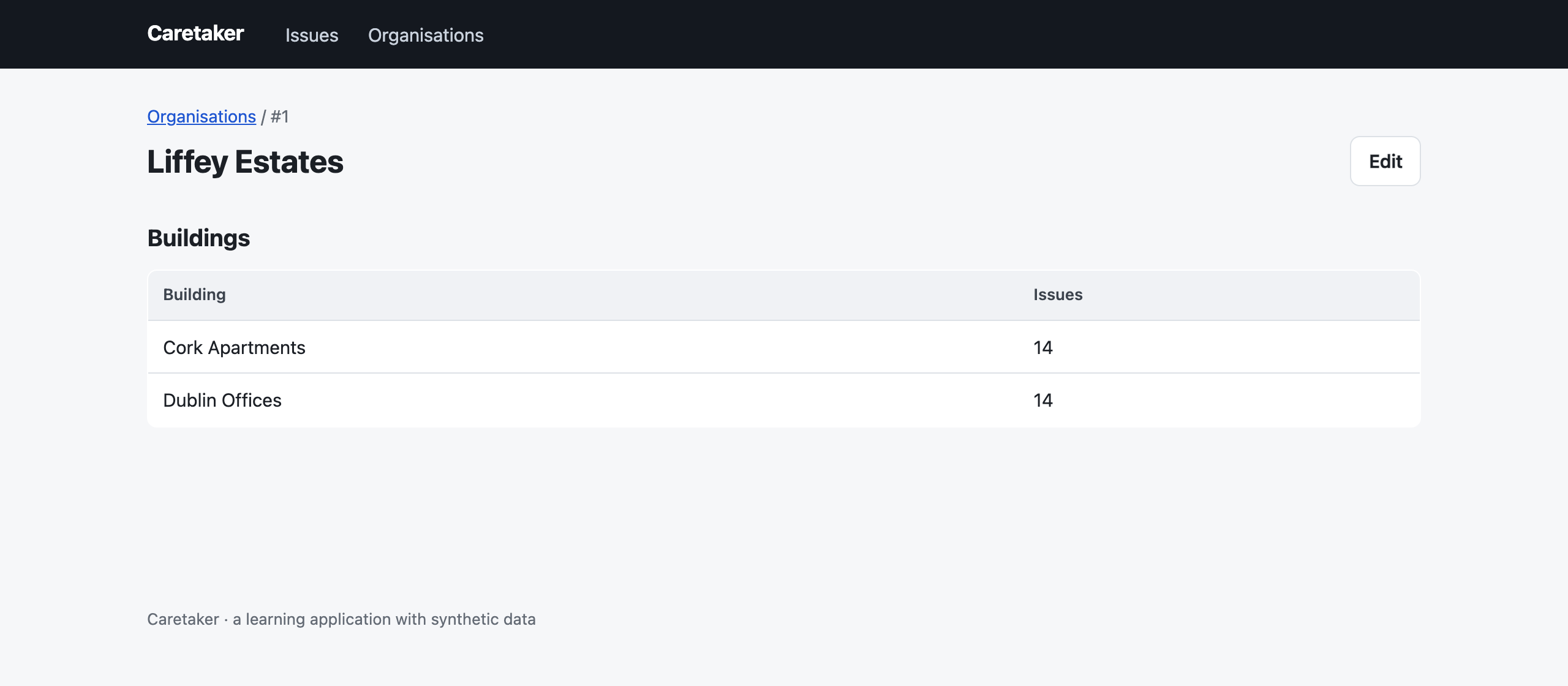
Experiment
organisationsRouter.get('/:id', ...). What does GET /organisations/new return, and why does it not try to load an organisation with the ID "new"?curl -s http://localhost:3000/organisations/new | grep "<h1>"
<h1>New organisation</h1>Reveal Answer
The router registered /new before /:id, and routers try routes in order, just like the app. Swap the two registrations and /organisations/new returns 404, because parseId('new') is null. Try it, then put the order back.
Checkpoint
npm test
> caretaker@1.0.0 test
> node --env-file=.env.test --test --test-concurrency=1 --test-reporter=spec "test/**/*.test.js"
✔ GET /issues lists issues from the database (68.240833ms)
✔ GET /issues/101 shows one issue with its building (3.808084ms)
✔ GET /issues/:id answers 404 for unknown or malformed ids (6.867417ms)
✔ POST /issues re-renders the form with errors (7.038625ms)
✔ POST /issues stores the issue and redirects to it (6.18575ms)
✔ POST /issues with a building that does not exist is a form error, not a 500 (9.519959ms)
✔ the stored row has the cleaned values (3.867292ms)
✔ GET /organisations lists organisations with building counts (53.907875ms)
✔ GET /organisations/1 shows its buildings, not other organisations' buildings (3.665667ms)
✔ POST /organisations validates and creates (9.790875ms)
✔ POST /organisations/:id/edit renames the organisation (5.303083ms)
✔ unknown organisations are 404 (4.21725ms)
ℹ tests 12
ℹ suites 0
ℹ pass 12
ℹ fail 0
ℹ cancelled 0
ℹ skipped 0
ℹ todo 0
ℹ duration_ms 383.072416git add -A
git commit -m "Organisations with routers"
[main 0d73888] Organisations with routers
11 files changed, 306 insertions(+), 75 deletions(-)
create mode 100644 src/lib/ids.js
create mode 100644 src/models/organisations.js
create mode 100644 src/routes/issues.js
create mode 100644 src/routes/organisations.js
create mode 100644 test/organisations.test.js
create mode 100644 views/organisations/form.ejs
create mode 100644 views/organisations/index.ejs
create mode 100644 views/organisations/show.ejsSymptom Cannot GET /issues after the refactor
app.use('/issues', issuesRouter) is missing, or the router's route is issuesRouter.get('/issues', ...) instead of issuesRouter.get('/', ...).
Symptom Building counts show as "2" (with quotes in JSON) or sort wrongly
The ::int cast is missing from count(...).
Recap and next step
Routers group the routes of one resource and are mounted at a prefix. Shared helpers (parseId) moved to src/lib. Organisations have list, show, create and edit, with one form template and a loadOrganisation helper that answers 404.
Next: deleting things safely, and buildings that belong to organisations.
Open the checkpoint files for lesson 3.1 (separate page; only files from this lesson and earlier)